Is Japan a “Layer Culture”? — A Roadmap to Japanese-Style DX Spun by Industrial Engineering and the Japanese Language
※本記事の後半には、英語圏の読者向けに英文(English Version)を掲載しています。 An English version of this article is available in the latter half for our international readers.
日本経済が低迷して久しいと言われて久しく、デジタル化という「第4次産業革命」の波にも乗り遅れていると指摘されています。かつて現在の財務大臣が、インドの大使に現状を尋ねた際、次のような言葉を返されたそうです。
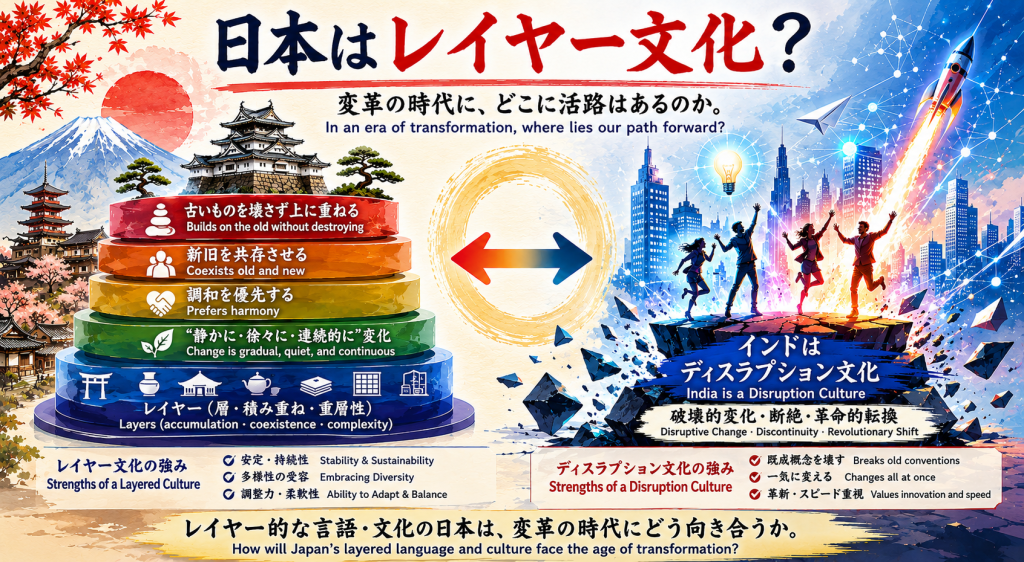
「日本はレイヤー文化であり、インドはディスラプション(破壊的変化)文化ですからね」
まさに、ITをベースにした大変革の時代において、インドのディスラプション(断絶・革命的転換)文化は、時代に適合しすぎているほど適合しています。では、もう一方の日本の「レイヤー文化」とは、一体どのようなものなのでしょうか。その特質を見つめ直すことで、私たちが進むべき未来の地図が見えてきます。
日本の「レイヤー文化」とは何か
レイヤーとは「層」「積み重ね」「重層性」を意味します。日本文化の本質は、以下のような特性に集約されます。
- 古いものを壊さずに上に重ねる
- 新旧を共存させる
- 調和を優先する
- 変化は“静かに・徐々に・連続的に”起こる
具体的な例を挙げればきりがありません。思想の面では、日本古来の神道の上に仏教が重なり、さらに儒教、国学、西洋思想が重なっても、古いものを「排除」するのではなく「折衷」「包含」してきました。建築や町並み、そして私たちの「言語」もまた、幾重ものレイヤーが積み重なって現在を形作っています。
日本語の持つ曖昧さや文脈依存性も、極めて「レイヤー的」です。日本語は、単語そのものだけでは意味が確定せず、その前後の層(文脈、関係性、空気)が積み重なって初めて、真の意味が立ち上がります。変化とは、連続性の中での微調整である――という世界観が根底にあるのです。
言語はその国の民族性や文化を創造すると言われます。だとすれば、この大変革の時代において、連続的・調整的なレイヤー言語を持つことは致命的なことなのでしょうか。それとも、ここにこそ活路があるのでしょうか。
高度経済成長をもたらしたレイヤー文化の成功事例
戦後、このレイヤー文化から生まれた日本最大の成功事例こそが、「品質管理(QC)」や「生産管理」と融合した「ものづくり」です。一般社員という現場のレイヤー(層)の中から、ボトムアップで提案がなされ、改善が積み重なっていく仕組みは、まさにレイヤー文化の典型例です。
実は、私はそれらを専門的に扱う大学工学部の経営工学科を卒業しています。日本の戦後復興から高度経済成長期にかけて、日本の製造業の本質を鋭く見抜き、世界へ発信し続けた論客に、システム工学者であり元東海大学教授、松下通信工業の常務などを歴任した「唐津 一(からつ はじめ、1919〜2016年)氏」がいます。
彼の数多くの著作や発言の中心にある主張は、「現場のものづくり(品質管理)こそが、経済と社会を発展させる原動力である」というものでした。日本の強みとされる現場のものづくりに、彼は「品質管理」という明確な軸を据えたのです。彼の主張は以下の4つの柱に集約されます。
- 「品質管理(QC)」は経営そのものである:品質管理を単なる「不良品を出さないための検査」と捉えるのは間違いであり、最初から不良品を作らないプロセス(仕組み)を構築し、全社一丸となって業務の質を高めること(TQC/TQM)こそが経営の本質である。
- 「マーケット・イン」の本質:「作れば売れる」というプロダクト・アウトの時代の終焉をいち早く予見し、消費者が本当に求めているものを徹底的に探り、製品開発にフィードバックする思想を強く訴えた。
- 日本流ものづくりの優位性と「知恵」の評価:1980年代の日米貿易摩擦の際、アメリカの製造業が「金融や理論(ペーパーマネー)」に傾倒していくのに対し、日本の強みは「工場の現場が自ら知恵を出し合ってカイゼンを重ねるボトムアップの力」にあると真っ向から反論した。
- 技術と人間性の調和:自動化やロボット工学の推進者でありながら、それは人間を排除するためではなく、「人間を単純労働から解放し、より創造的な仕事に向かわせるため(人間の幸福と社会の調和のため)」であるべきだと説いた。これは現代のAI社会にもそのまま適合する思想です。
「生産管理」と「品質管理」の違い、および経営工学(IE)
どちらも工場の運営には不可欠ですが、「何を最適化しようとしているか」の主眼が異なります。
- 生産管理(Production Management)
- 主目的: 効率よく、納期通りに、適切な量を安く作る。
- 主な指標: 納期(D)、コスト(C)、生産量、稼働率。
- 主な業務: 生産計画の策定、在庫管理、工程のスケジュール管理。
- 一言で言うと: 「モノの流れと量の管理」(効率・納期)
- 品質管理(Quality Control / QC)
- 主目的: 顧客が満足する「一定以上の質」の製品を作る。
- 主な指標: 不良率、顧客クレーム件数、分散(ばらつき)。
- 主な業務: 検査、工程分析、原因究明、カイゼン(改善)活動。
- 一言で言うと: 「モノの出来栄えとプロセスの管理」(信頼性)
関係性として、生産管理が「いつ、どこで、どれだけ作るか」という枠組みを決め、品質管理が「その枠組みの中で不良品を出さないように仕組み化する」という役割を担います。
当時(昭和中期まで)は、「品質を上げようと細かく検査すると、生産スピードが落ち、コストが上がる」と考えられていました。しかし唐津氏はこれを真っ向から否定し、「品質管理を徹底すれば、結果的に最高の生産管理になる」という高次元の論理を示しました。最初から不良品が出ない仕組みを作れば、手直し(やり直し)の時間がゼロになり、材料の廃棄もなくなるため、結果として生産スピードが上がり、コストが下がって効率が最大化するのです。
これらすべてを包み込む「親」のような学問・技術体系が、経営工学(Industrial Engineering / IE)です。人・モノ・設備・情報・エネルギーをトータルで最適化する学問であり、その位置づけは次のように図式化できます。
【 経営工学 (IE) 】:全体の最適化・システム設計 │ ├─► [ 生産管理 ] :量・納期・コストの最適化 │ └─► [ 品質管理 ] :質・プロセスの安定化と向上
唐津氏はまさにこの経営工学をバックグラウンドに持っていたからこそ、工場の一部分だけを見るのではなく、会社全体を一つの「有機的なシステム」として捉え、全体最適を提案することができたのです。
理論の唐津、実践のトヨタ――車の両輪がもたらしたもの
唐津一氏の品質管理思想と、トヨタ自動車が生み出した「トヨタ生産方式(TPS)」は、戦後日本のものづくりを世界一に押し上げた「車の両輪」であり、その根底にある哲学は深く結びついています。一言で言えば、唐津氏が「論理とデータ」で示した理想を、トヨタが「現場の具体的な仕組み」として極限まで実践・システム化したのです。
- 「不良を作らない」=「究極のムダとり」:トヨタの実践する「自働化(にんべんの付いた自動化)」は、異常があれば作業員が自らラインを止める仕組みです。これは、検査で不良品をハネるのではなく、最初から不良品を出さないプロセスをつくるという唐津思想の具現化です。
- 「カイゼン」の主役は現場の人間である:欧米の工場では「考える人(エンジニア)」と「動く人(作業員)」が明確に分かれていましたが、両者の思想は「現場が一番よく知っている。現場に知恵を出してもらおう」という、徹底したボトムアップ型の信頼関係で結ばれていました。
- 「マーケット・イン」と「ジャストインタイム」の融合:売れるかどうかわからないものを大量に作って在庫の山にすることを「悪」とみなし、後ろの工程(お客様)が消費した分だけを補充するシステムを確立しました。
日本人の勤勉さを育んだ精神的土壌(石田梅岩と鈴木正三)
そもそも、現場が勤勉でなければ、いくら優れたシステムがあっても生産管理も品質管理も成り立ちません。そして、その勤勉さもまた、日本の「レイヤー文化」から生まれています。
山本七平氏の名著『日本資本主義の精神』では、日本人が「なぜ一生懸命働くのか」という根源的な疑問に対し、江戸時代の思想前進が近代化の成功をもたらしたと説いています。西欧の資本主義がプロテスタントの禁欲的な労働観を土台にしているのに対し、日本では江戸時代の思想家である「鈴木正三(仏教者)」や「石田梅岩(儒学がベース)」が、独自の労働観を築きました。
労働を単なる生活の手段(ブラックな滅私奉公)と捉えるのではなく、各人の職業を神仏から授かった天職として全うする「職分」の思想、すなわち「仕事=生きがい・修行」とする強い労働倫理が形成されたのです。このように、日本文化のレイヤーの中で育まれた仏教や儒教という思想を基盤にして、日本人の勤勉さは確固たるものになりました。
第4次産業革命における「日本流デジタル・ものづくり復活への地図」
では、これらのアナログな財産を、現代のDX(デジタルトランスフォーメーション)の波の中でどう活かしていけばよいのでしょうか。現在、多くの日本企業がDXで苦戦しているのは、「プロセスがガタガタのまま、高価なITツール(道具)だけを導入しているから」に他なりません。欧米発の「人間をリプレイスするトップダウンの自動化」をそのまま導入しても現場は疲弊します。
私たちが目指すべきは、唐津思想とTPSをデジタルで再定義した、「現場の人間が主役となり、AIを相棒(コパイロット)として使いこなす、人間中心のDX」です。そのための3つのシフトとロードマップを提案します。
【 昭和・平成の強み 】 【 令和・第4次産業革命での進化 】 アナログな現場の知恵 ──(DXの融合)──► デジタル・クオリティ・コントロール (暗黙知・局所的最適) (全自動カイゼン・全体最適)
- 「QCサークル」から「データ駆動型AIサークル」へのシフト:かつて現場が「赤ペンとグラフ用紙」で行っていた統計的品質管理を、現代のAIとIoTに置き換えます。IoTセンサーが微細なばらつき(予兆)をリアルタイムで検知し、プログラミングができない現場の作業員が、ノーコードAIツールを使って自分たちの工程のデータ分析を自ら行う「全員参加のデジタル品質管理」を構築します。
- 「ジャストインタイム」のサプライチェーン全体への拡張:市場の消費者行動データをAIが解析し、エンドユーザーの「欲しい」という熱量が冷めないうちに、原材料調達から製造・物流までが自動で同期して動き出すサイバーフィジカルシステム(CPS)を構築します。
- 「暗黙知(ベテランの技)」のデジタル資産化と世界標準化:言語化されていない「職人の技(暗黙知)」を生成AIやデジタルツインを使ってデータ化し、高品質を生み出すアルゴリズムとしてパッケージ化。世界の製造業に向けて外販する「サービスとしての製造業(MaaS)」へとビジネスモデルを転換します。
🎯 日本経済復活への3ステップ・ロードマップ
- Step 1:足元の整流化
- 具体的なアクション: デジタルの前に、まず業務プロセスから「ムダ」を徹底的に省く(TPSの徹底)。
- 目指すゴール: アナログな非効率をデジタルで固定化する悲劇を防ぐ。
- Step 2:現場のリスキリング
- 具体的なアクション: 現場の作業員やミドルマネジメントに、データ分析やAIの基礎教育を行う。
- 目指すゴール: 「データを主体性を持っておもしろがる現場」を復活させる。
- Step 3:産業間データの連結
- 具体的なアクション: 自動車、電機、化学などの枠を超え、日本標準の「ものづくりデータ基盤」を構築する。
- 目指すゴール: 欧米のITプラットフォーマーに対抗できる、現場発のデータ生態系を創る。
結論:すべてを繋ぐのは「日本語のコミュニケーション力」
新時代の逆説として、唐津氏はかつて「品質を上げればコストが下がる」と言いました。DX時代における日本のスローガンは、「現場の知恵をデジタル化すれば、世界のイノベーションを追い抜ける」です。
しかし、ここで忘れてはならない原点があります。「匠の技」を現場から抽出し、DXのシステムへと載せるには、当然ながら強固なコミュニケーションが必要です。ボトムアップで提案を通す表現力、そして受けた提案を正しく理解し、吸い上げる力。それらはつまるところ、言葉の力に他なりません。
現在、海外から多くの優秀なITエンジニアが日本にやってきて、私たちの産業や社会のDX化を推進してくれています。彼らとの協働をより有意義な方向へと導くためにも、人と人とが深く触れ合うための「日本語のコミュニケーション力」が不可欠になります。現場の熟練の技を、国境を越えて誰もが使えるシステムへと昇華させるための原点は、まさに言葉の温もりと確かさにあるのです。あらゆる変革の基盤には、常に人と人とのふれあいがあることを、私たちは忘れてはなりません。
English Version
Is Japan a “Layer Culture”? — A Roadmap to Japanese-Style DX Spun by Industrial Engineering and the Japanese Language
It has long been said that the Japanese economy is stagnant, with critics pointing out that Japan has lagged behind in the wave of digitization known as the “Fourth Industrial Revolution.” Some time ago, when Japan’s current Finance Minister asked the Ambassador of India about the current situation, the Ambassador reportedly replied:
“Japan is a ‘layer culture,’ whereas India is a ‘disruption culture.’”
Indeed, in this era of monumental transformation driven by IT, India’s culture of disruption (drastic and revolutionary turnarounds) is perfectly suited to the times. But what exactly is Japan’s “layer culture”? By re-examining its true nature, we can discover the map for the path we should take toward the future.
What is Japan’s “Layer Culture”?
A “layer” signifies stratification, accumulation, and multi-layered depth. The essence of Japanese culture can be summarized by the following characteristics:
- Accumulating the new on top of the old without destroying it
- Allowing the old and the new to coexist harmoniously
- Prioritizing social harmony and balance
- Experiencing change quietly, gradually, and continuously
Concrete examples are endless. In terms of thought, Buddhism was layered upon ancient Japanese Shinto, and subsequently, Confucianism, Kokugaku (National Learning), and Western philosophy were added. Instead of “excluding” the past, Japan has historically “blended” and “embraced” it. Architecture, townscapes, and our very language have all been shaped by these multiple overlapping layers over centuries.
The ambiguity and context-dependency of the Japanese language are also highly “layered.” In Japanese, words alone do not dictate definitive meaning; rather, meaning emerges only when the layers before and after them—context, relationships, and the surrounding “air” (atmosphere)—are stacked together. At its core, this reflects a worldview where change is seen as a series of continuous, subtle adjustments.
It is often said that language shapes a nation’s identity and culture. If so, is possessing a continuous, adjustment-oriented “layered language” a fatal flaw in this era of disruption? Or does it hold the very key to our breakthrough?
Success Stories of Layer Culture That Brought the Economic Miracle
After World War II, the greatest success story born from this layer culture was Japanese “Monozukuri” (manufacturing), fused with Quality Control (QC) and Production Management. The mechanism where proposals are made bottom-up from the frontline layers of regular employees, accumulating into massive improvements, is a classic textbook example of layer culture.
In fact, I graduated from the Department of Industrial Engineering at a university’s Faculty of Engineering, which specializes in these very fields. One of the prominent thinkers who sharply saw through the essence of Japanese manufacturing and broadcasted it to the world during Japan’s post-war reconstruction and rapid growth period was Dr. Hajime Karatsu (1919–2016), a systems engineer, former professor at Tokai University, and former Managing Director of Matsushita Communication Industrial.
The core of his numerous writings and lectures was the conviction that “frontline manufacturing (Quality Control) is the ultimate engine that drives economic and social development.” He placed “Quality Control” as a definitive axis within Japan’s frontline strengths. His philosophy is condensed into the following four pillars:
- Quality Control (QC) is Management Itself: It is a mistake to view quality control merely as an inspection to filter out defects. The essence of management lies in building a process (mechanism) that prevents defects from being created in the first place, thereby elevating the quality of all operations across the entire company (TQC/TQM).
- The Essence of “Market-In”: He was among the first to foresee the end of the “Product-Out” era (where anything made would sell), strongly advocating the philosophy of thoroughly investigating what consumers truly desire and feeding that data back into product development.
- The Superiority of Japanese Monozukuri and the Value of “Frontline Wisdom”: During the US-Japan trade frictions of the 1980s, while American manufacturing leaned heavily toward finance and theory (paper money), Karatsu fiercely countered that Japan’s strength lay in the bottom-up power of factory floors generating collective wisdom to drive continuous “Kaizen” (improvement).
- Harmony Between Technology and Humanity: Although he was a pioneer in automation and robotics, he maintained that technology should not be used to eliminate humans, but rather to “free humans from repetitive labor and direct them toward more creative endeavors for human happiness and social harmony.” This philosophy perfectly aligns with our modern AI-driven society.
The Difference Between Production Management and Quality Control, and the Role of Industrial Engineering (IE)
While both are indispensable to factory operations, they differ in what they aim to optimize:
- Production Management
- Primary Goal: Manufacturing products efficiently, on schedule, in appropriate quantities, and at low costs.
- Key Metrics: Delivery (D), Cost (C), Production Volume, Capacity Utilization.
- Core Tasks: Formulating production plans, inventory control, and scheduling processes.
- In Short: “Managing the flow and quantity of goods” (Efficiency & Delivery).
- Quality Control (QC)
- Primary Goal: Manufacturing products with a “consistent level of excellence” that satisfies customers.
- Key Metrics: Defect rate, customer complaints, and variance (bility/scatter).
- Core Tasks: Inspections, process analysis, root-cause investigations, and Kaizen activities.
- In Short: “Managing the excellence of products and processes” (Reliability).
In terms of their relationship, Production Management sets the framework of “when, where, and how much to build,” while Quality Control builds the system within that framework to ensure no defects are produced.
Back in the mid-20th century, the conventional belief was that “inspecting meticulously to increase quality slows down production speed and raises costs.” Dr. Karatsu utterly rejected this, presenting a higher-dimensional logic: “Thorough quality control ultimately results in the highest efficiency of production management.” By creating a process where defects do not occur from the start, the time spent on rework drops to zero, and material waste is eliminated. Consequently, production speed accelerates, costs drop, and efficiency is maximized.
The parent discipline that encompasses all of this is Industrial Engineering (IE). It is a field of study and technology dedicated to the total optimization of people, materials, equipment, information, and energy. Its structure can be mapped as follows:
[ Industrial Engineering (IE) ]: Total Optimization & System Design │ ├─► [ Production Management ]: Optimizing Volume, Delivery, and Cost │ └─► [ Quality Control ]: Stabilizing and Enhancing Quality and Processes
Because Dr. Karatsu possessed a background in Industrial Engineering, he did not look at a factory as isolated parts; instead, he treated the entire enterprise as a single “organic system” and proposed holistic, total optimization.
Karatsu’s Theory and Toyota’s Practice — Two Wheels of a Cart
Dr. Hajime Karatsu’s quality control philosophy and the “Toyota Production System (TPS)” were the two wheels of the cart that propelled post-war Japanese manufacturing to the top of the world. Their underlying philosophies are deeply intertwined. In short, Toyota took the ideals that Karatsu demonstrated through “logic and data” and thoroughly practiced and systematized them into concrete, frontline mechanisms.
- “Zero Defects” Equals the “Ultimate Elimination of Waste”: Toyota’s practice of “Jidoka” (Automation with a human touch) empowers frontline workers to stop the production line immediately if an anomaly is detected. This embodies Karatsu’s philosophy of building a process that prevents defects rather than just sorting them out at the end.
- Frontline Workers as the Protagonists of “Kaizen”: While Western factories clearly separated “thinkers (engineers)” from “doers (operators),” both Karatsu and Toyota shared the philosophy that “the frontline knows best; let us gather their wisdom.” This formed a deep relationship of trust based on a bottom-up approach.
- Fusing “Market-In” with “Just-In-Time”: Treating the mass production of unsold goods as the ultimate “waste,” they established a system that replenishes items only in the exact amount consumed by the next process (the customer).
The Spiritual Ground That Nurtured Japanese Diligence (Ishida Baigan and Suzuki Shosan)
Ultimately, no matter how excellent a system is, neither production management nor quality control can function if the frontline workers lack diligence. And that very diligence is also a product of Japan’s “layer culture.”
In his masterpiece The Spirit of Japanese Capitalism, Shichihei Yamamoto addresses the fundamental question of “Why do Japanese people work so hard?” He explains that the philosophical maturation during the Edo period paved the way for Japan’s successful modernization. While Western capitalism is built upon the Protestant work ethic of ascetic labor, Japan developed its own unique view of labor through Edo-period thinkers like Suzuki Shosan (a Buddhist monk) and Ishida Baigan (rooted in Confucianism).
They did not view labor merely as a means to survive (or as blind, abusive self-sacrifice). Instead, they established a profound labor ethic where one’s occupation is viewed as a “heavenly calling” granted by the divine—essentially, “work equals a purpose in life and spiritual training.” By absorbing these Buddhist and Confucian ideals into the layers of Japanese culture, a rock-solid foundation of diligence was forged.
The Map for Resurrecting Japanese-Style Digital Manufacturing in the Fourth Industrial Revolution
How can we leverage these rich, analog assets within the modern wave of DX (Digital Transformation)? Today, many Japanese companies struggle with DX simply because they introduce expensive IT tools while leaving their underlying operational processes messy and disorganized. Importing Western-style, top-down automation that aims to completely replace humans only leads to frontline exhaustion.
What we must aim for is a “human-centric DX” where frontline workers remain the protagonists, utilizing AI as their co-pilot—a digital redefinition of Karatsu’s philosophy and TPS. To achieve this, I propose three shifts and a roadmap:
[ Strengths of Shōwa & Heisei ] [ Evolution in the 4th Industrial Revolution ] Analog Frontline Wisdom ──(DX Fusion)──► Digital Quality Control (Implicit Knowledge / Local) (Fully Automated Kaizen / Total Optimization)
- Shifting from “QC Circles” to “Data-Driven AI Circles”: Replace the statistical quality control once done by the frontline using “red pens and graph paper” with modern AI and IoT. IoT sensors can detect minute variances (signs of trouble) in real-time, allowing frontline workers—even those without programming skills—to perform data analysis using no-code AI tools, achieving “all-participant digital quality control.”
- Expanding “Just-In-Time” Across the Entire Supply Chain: Use AI to analyze consumer behavior data in the market, allowing raw material procurement, manufacturing, and logistics to synchronize automatically before the consumer’s enthusiasm cools down, building a seamless Cyber-Physical System (CPS).
- Turning “Implicit Knowledge (Veteran Skills)” into Digital Assets and Global Standards: Digitizing unvoiced “craftsman skills” through generative AI and digital twins, packaging them into high-quality algorithms. This shifts the business model toward “Manufacturing as a Service (MaaS),” exporting these packages to global markets.
🎯 Three-Step Roadmap for Japan’s Economic Resurrection
- Step 1: Streamlining the Foundation
- Action: Prior to digitization, thoroughly eliminate “waste” from business processes (Full implementation of TPS).
- Goal: Prevent the tragedy of locking analog inefficiencies into permanent digital systems.
- Step 2: Frontline Reskilling
- Action: Provide basic education on data analysis and AI to frontline workers and middle management.
- Goal: Revive a frontline that takes proactive ownership and genuinely enjoys working with data.
- Step 3: Connecting Inter-Industrial Data
- Action: Break down the barriers between industries (automotive, electronics, chemicals, etc.) to build a unified, Japan-standard “Manufacturing Data Infrastructure.”
- Goal: Create a frontline-driven data ecosystem capable of competing against Western IT giants.
Conclusion: “Japanese Communication Power” Ties Everything Together
In a paradox of the new era, Dr. Karatsu once noted that “raising quality lowers costs.” In the age of DX, Japan’s slogan should be: “Digitizing frontline wisdom allows us to leapfrog global innovation.”
Yet, we must never forget our true starting point. To extract “craftsman skills” from the frontline and load them onto DX systems, strong communication is absolutely vital. The expressive power to push proposals upward from the bottom, and the capacity to correctly understand and absorb those proposals at the top—all of this ultimately distills into the power of words.
Today, many talented IT engineers from overseas are coming to Japan, driving the DX of our industries and society. To make collaboration with them truly meaningful, a compassionate “Japanese communication power” that connects people deeply is essential. The origin of sublimating refined frontline skills into a universally accessible system across borders lies precisely in the warmth and clarity of language. We must never forget that at the foundation of all great transformations, there is always the bond of human connection.
 Shinpi Me